
Time and Space | The ShelterPhysics Blog
Posts Filtered by Tag - Pedagogy |
Show Recent Posts
October 21, 2025
Obscure the Model, Obscure the Physics
Obscure the Model, Obscure the Physics
In their zeal to popularize physics, and to collect followers, sometimes physics influencers are too clever by half.
Today I became aware of a physics YouTube channel created by David Jackson, a professor at my undergraduate alma mater, Dickinson College. I watched an episode called "The Most Mind-Blowing Aspect of Circular Motion.” The videography and story telling is so good. But an opportunity has been lost.
The stated theme of Prof. Jackson's video is that the behavior of a ball on a string, swung in a circle and released, is not what physics teachers say it is, and even physicists "get it wrong." This claim is misleading at best.
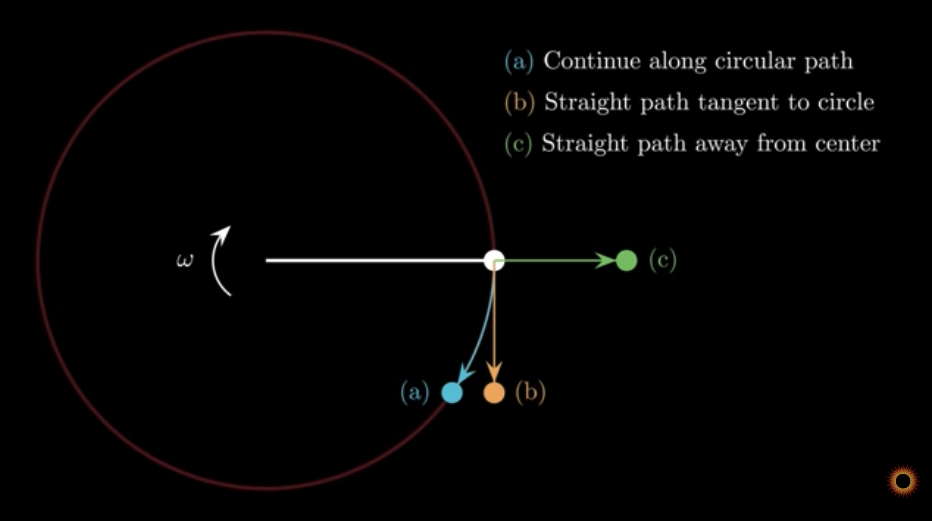
The central exam question in Dr. Jackson's video relates to the initial path of an object swung in a circle by a string, when the string is released. On a first-year physics exam, the answer would be (b). Jackson's claim is that the correct answer is (a).
Physics is about modeling objects and systems, something Prof. Jackson never mentions. When physics teachers cover circular motion, and the ball/string example in particular, they clarify that a simplified model with a massless, infinitely stiff string is being used. In that model, the force of the string disappears instantly when it is released, the string does not influence the motion of the ball, the ball instantly starts to travel in a straight line, and (b) is the correct answer.
We know that strings are not, in fact, massless and infinitely stiff. The video explores the consequences of the "real world" time lag between when the string is released and when the ball experiences a change in forces upon it, during which the ball’s motion remains circular. That’s it. Indeed, the bulk of the video is not about circular motion at all; it’s about wave propagation: a fascinating topic, but one tangential to circular motion. (I'm here all week. More cringe physics teacher jokes to follow. 🙄)
Good physics teachers always make sure their students understand how objects are being modeled. I used to joke: “We paid extra for the frictionless pulleys and massless strings.”
Another joke I would tell relates to balanced forces on someone sitting in a chair. The chair’s job is to balance the weight of the person on it. I would say, "When a lineman on the football team gets up, and a flyer on the cheer squad sits down, how does the chair know not to put on the same amount of force and shoot the cheerleader up to the ceiling?” Of course, in our simplified model, the chair is not even an object, just the source of an outside force on the person sitting in it. In our model, we are ignoring the chair's behavior—it compresses less under the weight of the cheerleader, and its force decreases.
If our goal is to engineer a device or to study a scenario in great detail, every model in first-year physics would be too simple. If our goal is to learn basic physics though, those simple models are exactly what is needed. We should not be surprised when real world behaviors emerge which cannot possibly be predicted by our simple models.
And if one's goal is to entertain, to be able to say things like, “Even physicists get it wrong,” they will tuck modeling into their back pocket, which obscures the very process of physics we want students to appreciate. Doing so makes physics seem mysterious and tricky, the opposite of what physics actually is.
Thus, what Prof. Jackson alluded to, but should have said explicitly, is that the behavior of the ball approaches answer (b) as the behavior of the object holding the ball approaches that of the idealized string. Further, the ball does begin traveling in a straight line the instant the force from what's holding it disappears, just as Newton's laws predict. The "mind-blowing aspect of circular motion" turns out to be more about semantics than physics.
As always, good physics teaching is model-forward physics teaching.

September 19, 2024
Process-Based Physics Education
Process-Based Physics Education
Principles or formulas? Content or process? Effective physics education focuses on all of these, and more.

A meme making the rounds of social media attributes the following quote to Richard Feynman: "Teach principles, not formulas. Understand, don't memorize." If Feynman actually said this, and and I cannot find a definitive source proving he did, it would be out of character for him to be so imprecise. I suspect there was context around this statement the meme is ignoring.
While it's certainly true that memorizing facts and formulas isn't a useful approach to learning physics, ignoring facts and formulas is equally stifling. Formulas are the concise and powerful outcome of our physical understanding of the world, and spoken-word principles don't give us the insights needed to put our knowledge to work.
As an example, let's consider Einstein's theory of special relativity. Its principles include two postulates—that physical laws are identical in all inertial reference frames, and that the speed of light is the same for all observers. Working the postulates into classical kinematics and dynamics yields additional principles, notably mass-energy equivalence and the existence of a spacetime continuum governed by time dilation and length contraction. Reading about the elasticity of space and time predicted the the theory of special relativity has been a source of wonder for physicists and layman alike. But why stop there?
Special relativity formulas rely on the same algebra most of us learned in high school.

With these formulas and a little Googling for values, we can learn why time dilation and length contraction are not readily observable at the typical speeds of terrestrial objects. Or we can determine that the energy produced by a typical nuclear power plant in a day can be obtained from about one gram of matter, the mass of a small paper clip.
A third important consideration, beyond principles and formulas, is the connection between the two: In other words, the answer to the question, "Where do formulas come from?" The time dilation formula above can be derived from the principles of special relativity using simple geometry.
Finally, it's worth getting to the bottom of how experimental inquiry, in this case the Michaelson and Morley experiment which established the invariability of the speed of light, leads to the development of new principles and formulas.
In all of these ways, revealing to students the processes of physics, and expecting them to draw evidence-based conclusions from data, from principles, and from formulas, builds in them the confidence needed to become rational problem solvers in their careers and in their lives. The curricula of the present-day AP Physics courses—their dependence on requiring students to "justify their answer," "explain their reasoning," "determine," and "calculate"—encourage students to engage in the processes of physics. Process-based activities and assessment can be infused into physics courses at all levels.
As "grist for the mill," memorization of principles and content is a good thing, so long as it doesn't end there. Processes (laboratory inquiry, derivation, applied reasoning) are the strands connecting content (principles and formulas) into a web of understanding.
SEARCH NEWS ITEMS
SEARCH ARTICLES
POSTS BY TYPE
POSTS BY TAG
POSTS BY MONTH