
Time and Space | The ShelterPhysics Blog
Posts Filtered by Tag - Waves |
Show Recent Posts
May 24, 2025
Beach Cusps on the Block Island Shore
Beach Cusps on the Block Island Shore
Last time, I engaged in informed speculation about the origin of regularly-spaced rock piles on the Block Island shore. Turns out, these formations have a name—beach cusps—and there is so much more to the story.
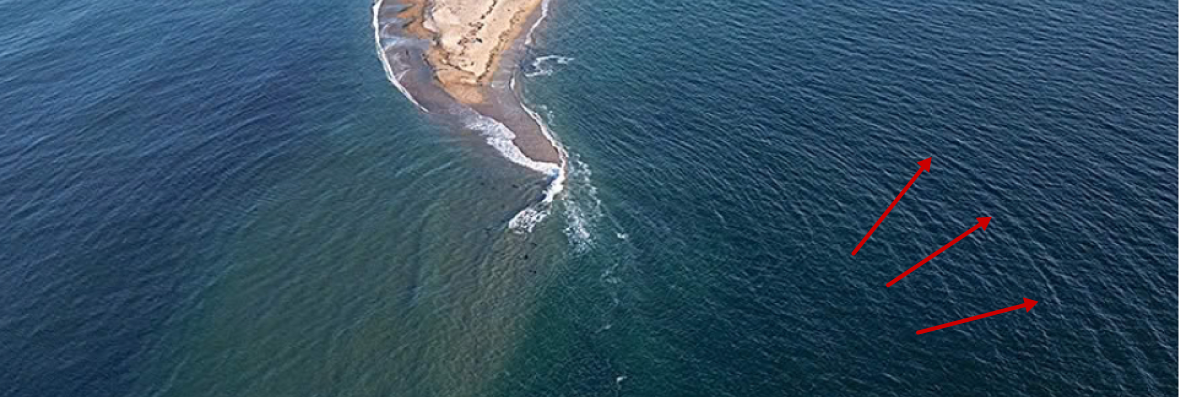
Shortly after returning from Block Island, social media did what it does and supplied me with a beautiful drone shot of the Sandy Point side of the island, complete with wave formations in the ocean and scallop-shaped cusps on the shore.
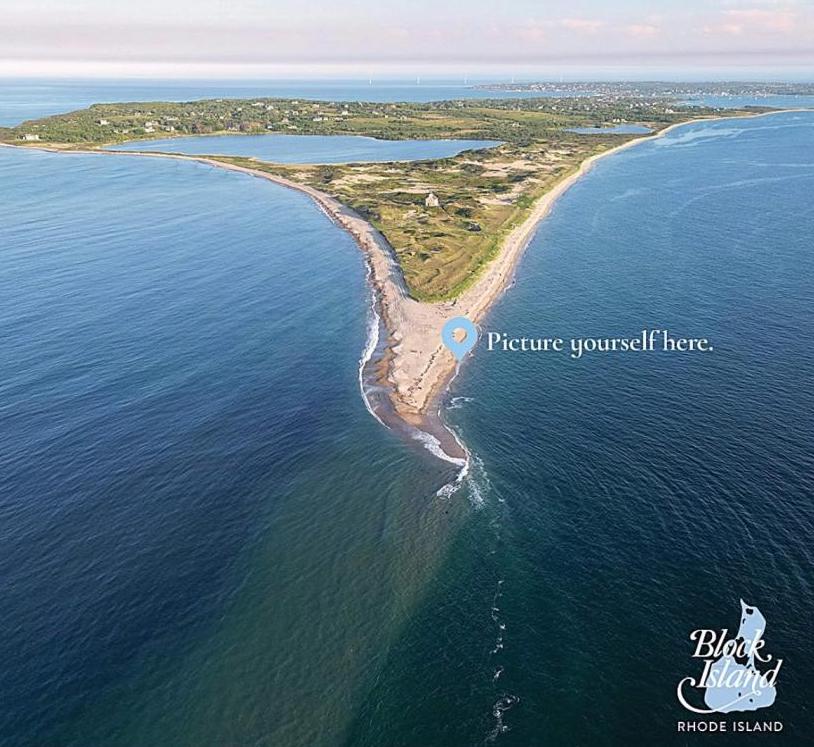
As I had been on that very shore days ago, it was easy to "picture myself here," sharing the beach with my wife, some seagulls, and a hundred or so migrating seals.
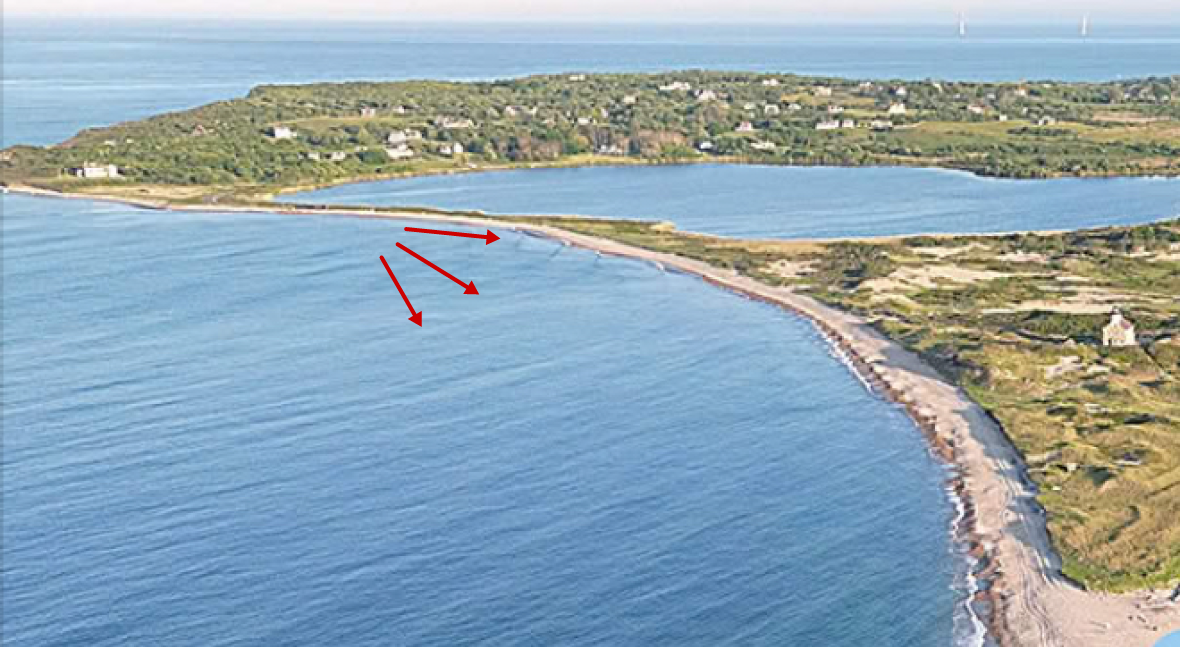
Let's first dispense with the things I would have brought into my classroom during the "Waves" unit (1-3), then move on to the feature of most interest in further exploration of beach cusps (4):
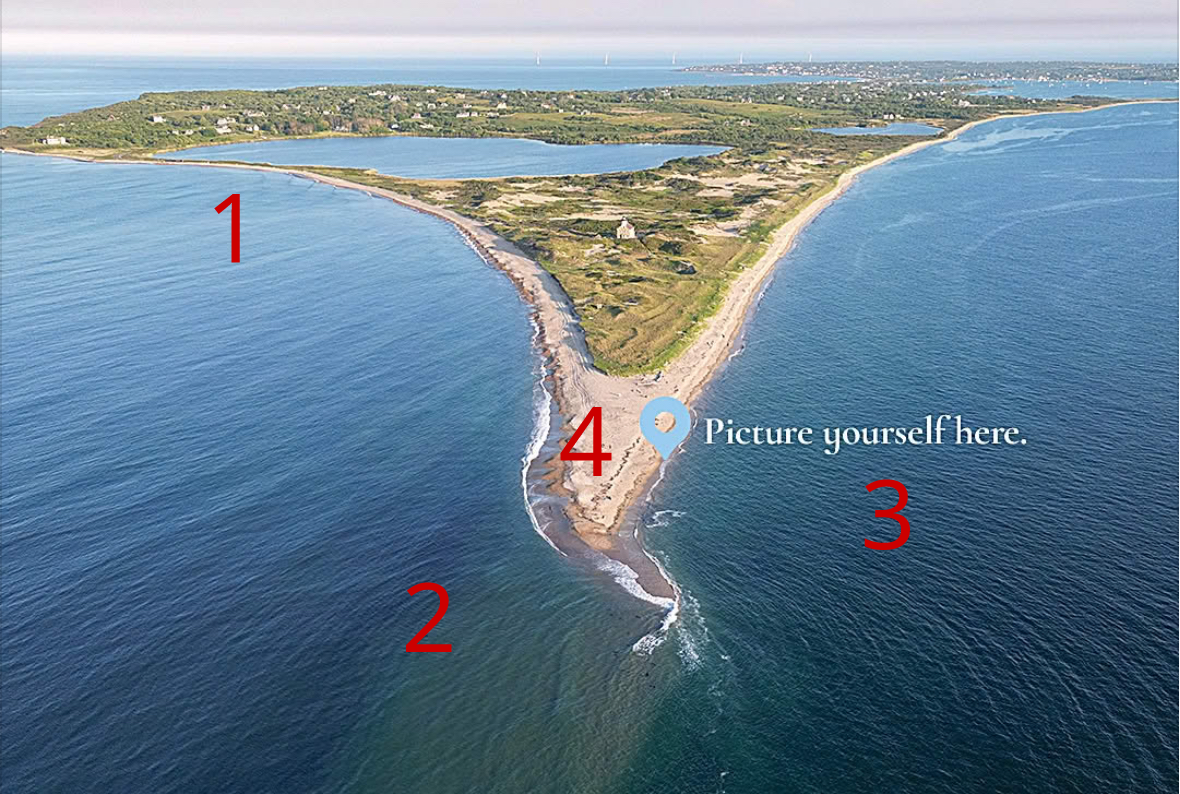
- Refraction of water waves results in a circular wave front approaching the shore. The refraction occurs because the wave front approaches shore at an angle. The far-field side of the wave slows down in shallow water while the near-field side continues apace.
- Reflection of water waves can be observed from the shallow bar at Sandy Point. Such reflection occurs at boundaries where wave speed changes.
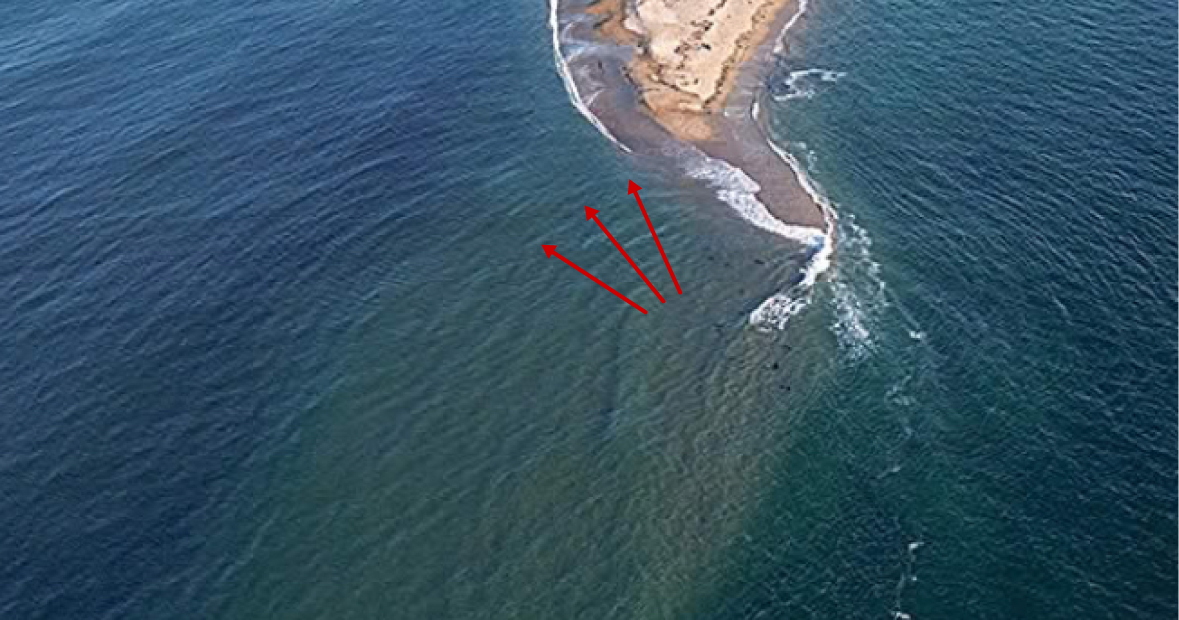
- Diffraction around Sandy Point occurs because part of a wave front is blocked, leading to circular waves bending around the barrier.
- Cusps along the entire windward beach, a more comprehensive record of the alternating pattern of rock piles and eroded areas described last time, were evident from the air.
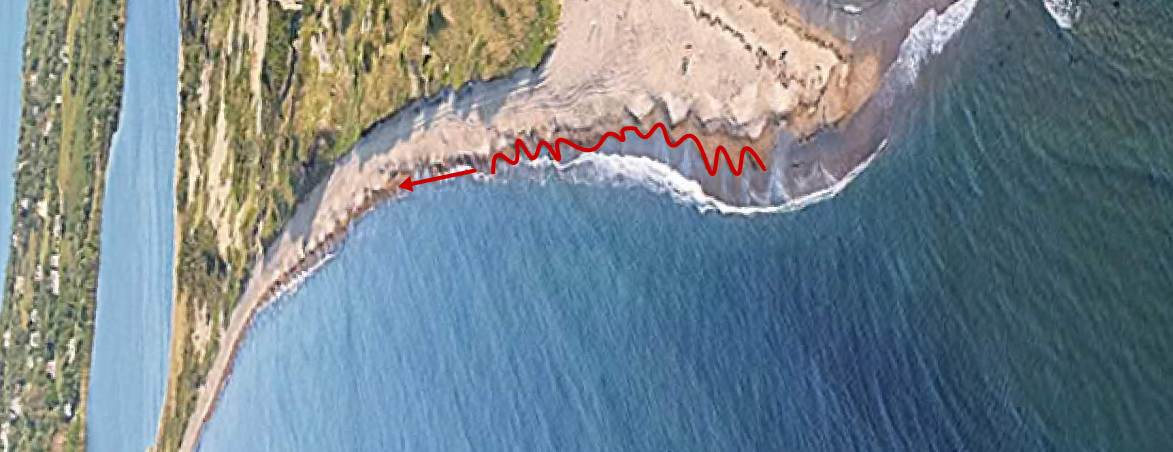
What I failed to notice as a beach walker was crystal clear from seagull's eye view.
Substance
Via an Internet search and using various reliable sources, I was able to get a sense for the state of research on beach cusps. The cusps comprise alternating horns, piles of sediment projecting outward from shore, and embayments, hollowed-out areas of sediment sometimes filled with water (depending upon the water level). Thus, the serrated appearance of beachfront upon which cusps have formed.
Some sources indicate that cusps are more commonly found on beaches with varying sizes of sediment: fine sand intermixed with larger rocks. Horns tend to be made up of larger sediment pieces, while the bed of embayments is mostly smaller pieces. That description certainly applies to the cusps on Block Island.
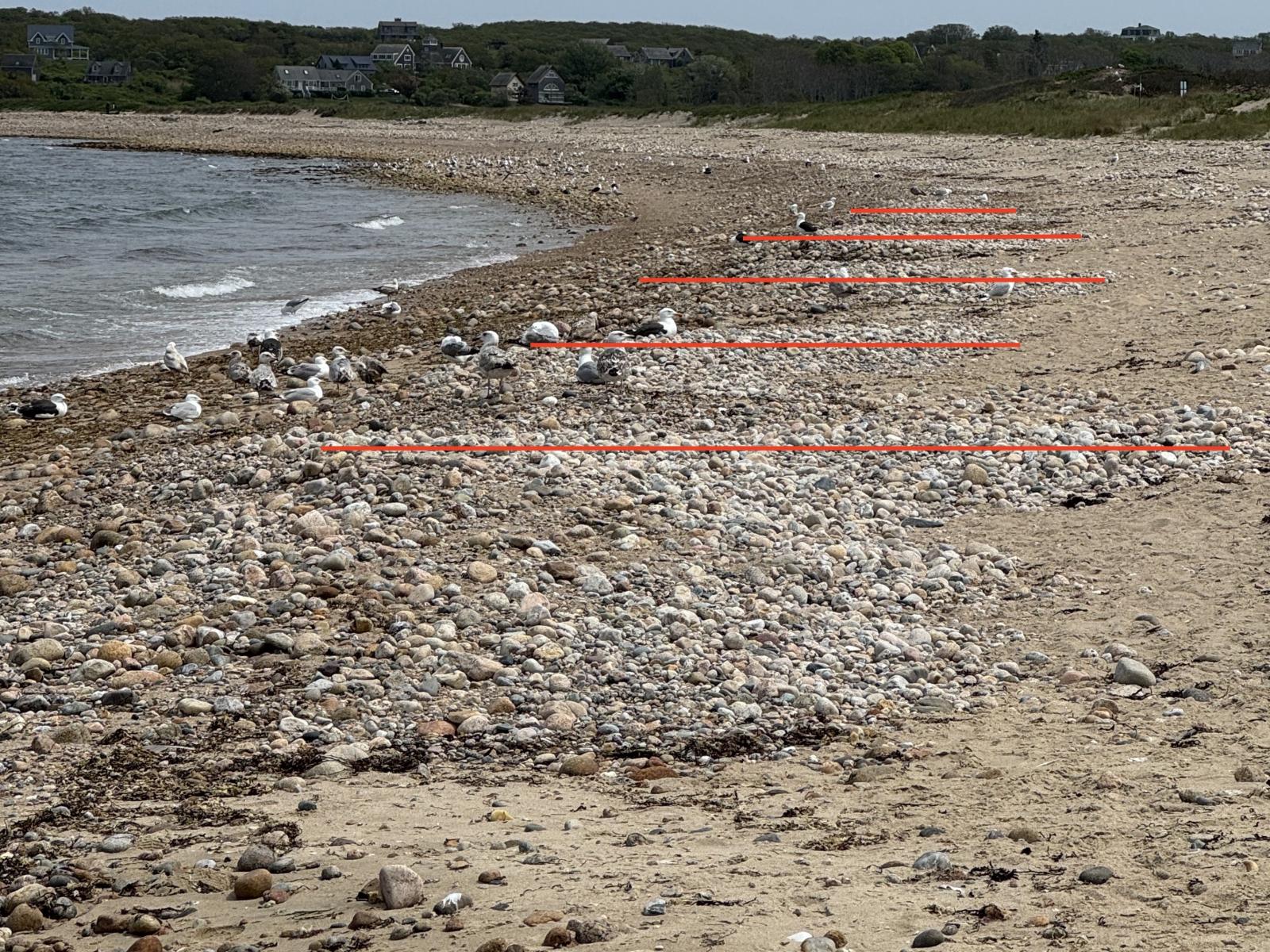
On Block Island, horns (marked in red) consist of the largest sediment pieces on the beach.
Currently, there are two credible models (source material often refers to them erroneously as theories, which would require greater consensus).
In the self-organization model, small variations in the contour of the beachfront yield a sort of positive-feedback loop, where impinging waves penetrate further into existing low spots. As horns and embayments form, the horns slow impinging waves, causing them to deposit the larger sediment pieces they are carrying on top of the horns. Receding water accumulates in the embayments. Dropping the sediment it is carrying transfers energy to the water which has washed ashore, further accelerating the hollowing-out of the embayments as the water recedes.
In the self-organization model, small variations in the contour of the beachfront yield a sort of positive-feedback loop, where impinging waves penetrate further into existing low spots. As horns and embayments form, the horns slow impinging waves, causing them to deposit the larger sediment pieces they are carrying on top of the horns. Receding water accumulates in the embayments. Dropping the sediment it is carrying transfers energy to the water which has washed ashore, further accelerating the hollowing-out of the embayments as the water recedes.
The self-organization model does not explain the early stages of cusp formation, which would be expected to consist of smaller cusps joining to form larger ones. Observations show that there is a consistent spacing of cusps throughout their formation.
In the edge wave model, standing waves which run parallel to shore create embayments in areas of constructive interference, and horns in areas of destructive interference. These waves, called edge waves, form from infragravity waves: long-period, low amplitude surface waves created near the shoreline by interactions between the larger, shorter-period waves we typically observe by eye. Owing to their low frequency, infragravity waves moving away from the shoreline refract back toward it, trapping wave energy and forming standing waves where water meets beach.
N.B., infragravity waves are better referred to as "subharmonic waves." The term "infragravity" comes from their lower frequency compared to "gravity" waves, which are formed directly by wind elevating a line of water along the surface. The water subsequently falls back toward Earth due to gravity, creating the rhythmic column of crests and troughs we normal associate with waves in large bodies of water.
The edge wave model does a poor job of explaining why cusps continue to grow after their inception. The serrated beachfront would inhibit the continued formation of consistent edge wave interference patterns, and the energy of edge waves may not be sufficient to build the robust beach cusps we observe.
What remains unclear in my research is why scientists believe one or the other of these models must dominate. From my brief exposure to this topic, it seems the edge wave model would better explain why beach cusps form, while the self-organization model would better explain why they grow. Perhaps there is an underlying reason why the models are incompatible, but I did not discover it in my readings.
What of my original conjecture that interference of waves causes beach cusps? While interference could be the cause, clearly I got the mechanics wrong by oversimplifying the waves present at the coastline. Interestingly, even the detailed models created by those studying beach formations as their principle line of research have been characterized as "radical oversimplifications." The motion of water in the surf zone is surprisingly and maddeningly complex.
And here is where I shall leave the subject of beach cusps for now, as I continue to appreciate the remarkable environment of Block Island apart from scrutiny of its origins.
N.B., evidence has discredited earlier models, most notably the shore-drift model, related to the mechanics through which wave-like formations in the seabed, so-called "sand waves," are formed by the action of water waves.
Process
Process has been as important as substance in this unfolding story on beach cusps. Specifically:
- Curiosity led to an initial inquiry and conjecture, in other words, to a scientifically-informed question: did interference of ocean waves create the observed beach cusps?
- The inquiring mind, mine, deferred to prior knowledge about interference to formulate a possible explanation. In other words, scientists are human and succumb to the tendencies covered under the old adage, "To a hammer everything looks like a nail." That's not a knock on the scientific process or on me, merely an admonishment that first steps always lead to a longer hike toward a more complete answer.
- Micro-effects, in this case infragravity waves giving rise to edge waves, often underlie effects observable at human scale.
- Dive deeper, and you won't likely find bottom. In spite of the breadth and depth of scientific knowledge, a virtually unlimited number of questions remain for which there are no solid answers.
Sources
Beach Cusps, Wikipedia
Edge Waves, ScienceDirect
On the Origin of Infragravity Waves, Terri Cook, Eos
Shoreline Processes and Sediment Responses Related to the Origin of Beach Cusps on Whidbey and Fidalgo Islands, Washington, John V. Spasari, Western Washington University
Beach Cusps: Shoreline Symmetry, Gary Griggs, Coastal Care
More mathematical detail:
Edge Wave, Coastal Wiki
Infragravity Waves, Coastal Wiki
Beach Cusps, Coastal Wiki

May 21, 2025
Interference of Ocean Waves
Interference of Ocean Waves
Rocks on a beach yield evidence of interference in ocean waves.

While beach walking on Block Island, I saw regularly-spaced rows of rocks. Interference of ocean waves from different sources offers one possible explanation. The diagram below illustrates the concept.

Two sets of wavefronts impinge upon the beach. In this simple example, the waves are identical and are impinging at symmetrical angles. Lines of constructive interference (dotted lines) move straight toward the beach. Rocks would be pushed into piles, which would accumulate in areas of destructive interference. In more general cases, there still would be lines of constructive and destructive interference, although they might not impinge upon the beach at right angles.
To apply some reasonable values to the above example, we consider piles of rocks which are 4 m apart created by waves of wavelength 2 m. In the drawing below, the two right triangles share a common hypotenuse, shown in red.


Of course, this analysis is not valid unless we can identify sources for the waves impinging on the beach at different angles. Unfortunately, my travel plans did not include the hours necessary to witness waves at high tide over a period of days. 🙂
But we can speculate. Does the shape of the beach produce reflections which converge at the location of the rock piles? Does the ferry traffic less than a mile offshore produce wakes which interfere with naturally-occurring waves?

One thing is for certain: Physics was not on the minds of the many harbor seals using Block Island as a waypoint along their migration route. ❤️

SEARCH NEWS ITEMS
SEARCH ARTICLES
POSTS BY TYPE
POSTS BY TAG
POSTS BY MONTH