
Time and Space | The ShelterPhysics Blog
Posts Filtered by Type - Insights |
Show Recent Posts
June 19, 2025
Object-ively Speaking
Object-ively Speaking
The object in a physics problem can be whatever you want it to be. Playing with different choices can save time and effort in the long run, and lead to a better understanding of the system you are exploring.
Before Derek Muller's Veritasium video series blew up, and leveled up, the content was often basic and useful for illustrating concepts in classical physics. In one such video, Derek poses a question about two beakers, each on one side of a dual-pan balance. The beakers contain the same amount of water. In one beaker, a low-density sphere is suspended from the bottom of the beaker by a string. In the other, a high-density sphere is submerged, held up by a string. When the balance is released, will it tip one way or the other? Which way? Or will it remain motionless?
In a reveal video that follows the set up video, neither Derek's explanation, nor those I read in the comments, resonates with me. We can't use Newton's laws to analyze this system without explicitly defining the objects in it. The explainers weren't doing that.
In defining objects, we have numerous options:
- We can consider the spheres, the water, and the beakers as separate objects.
- We can group each beaker, the water it contains, and the sphere it contains into a single object.
- We can group the water with the sphere or the beaker with the water.
Gro(u)ping for Clarity
I played with this problem for a minute before realizing that a straight line path to understanding exists. To form objects that are easy to compare, we might wish to group each beaker and the water it contains, while leaving out the spheres.
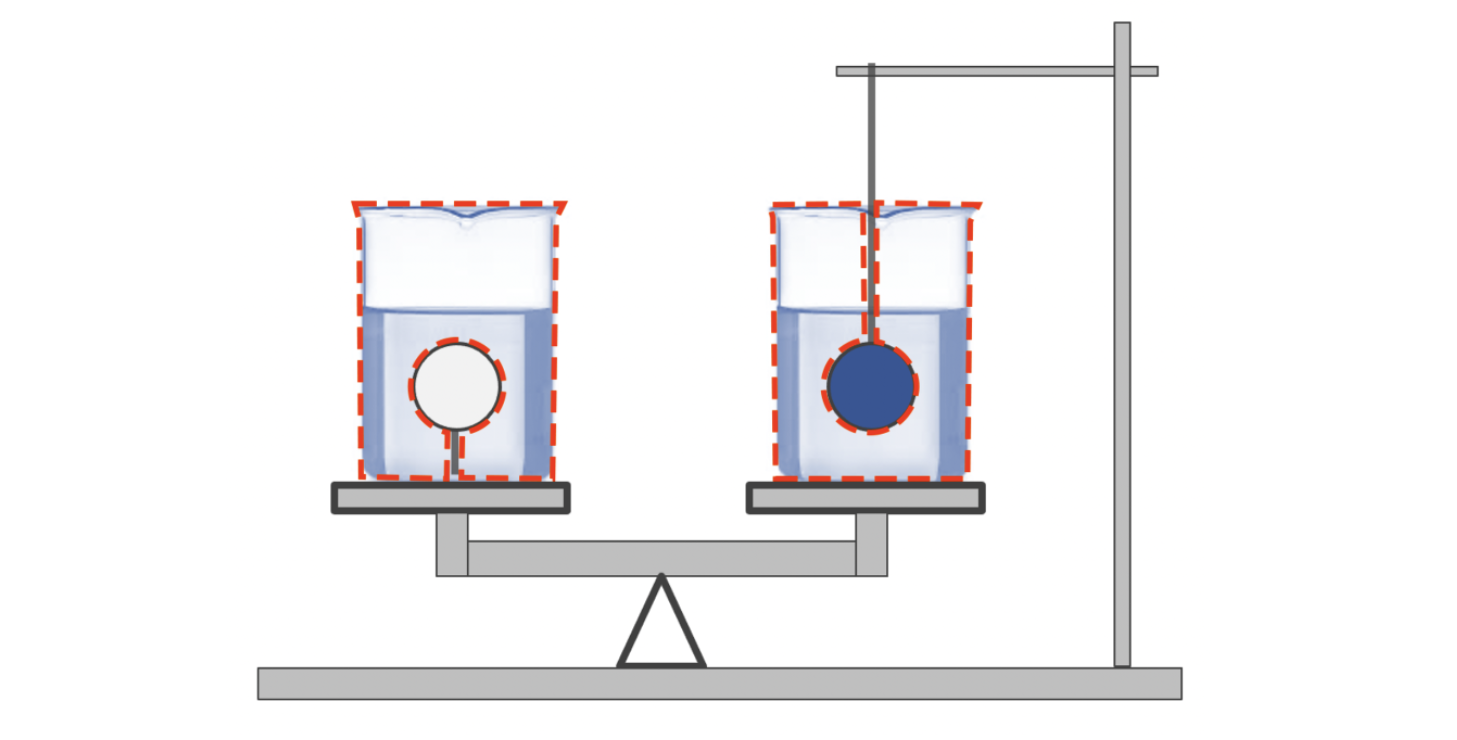
Our two beaker-water objects, which are identical but experience different forces.
Mechanics problems such as this can be approached by outlining the object and looking for physical contact with other objects. "What's touching? List those forces, then add gravity." The key difference between the two beaker-water objects? One has a string attached, pulling upward. The other does not! Thus, we predict that the upward force from the string will reduce the normal force on the balance, causing the balance to tip up on the left-hand side.
More detail:
- Both objects are being pushed upward by a normal force from the balance. If the normal forces are different, the side with the smaller normal force will tilt up.
- Both objects contact the spheres in them and exert an upward buoyant force, leading to a downward reaction force. The buoyant forces are the same, because the volume of the spheres is the same.
- The objects are equal in mass, so they have the same weight.
- The object on the left has a string attached, pulling upward. As we have said, this tension force is absent on the right.
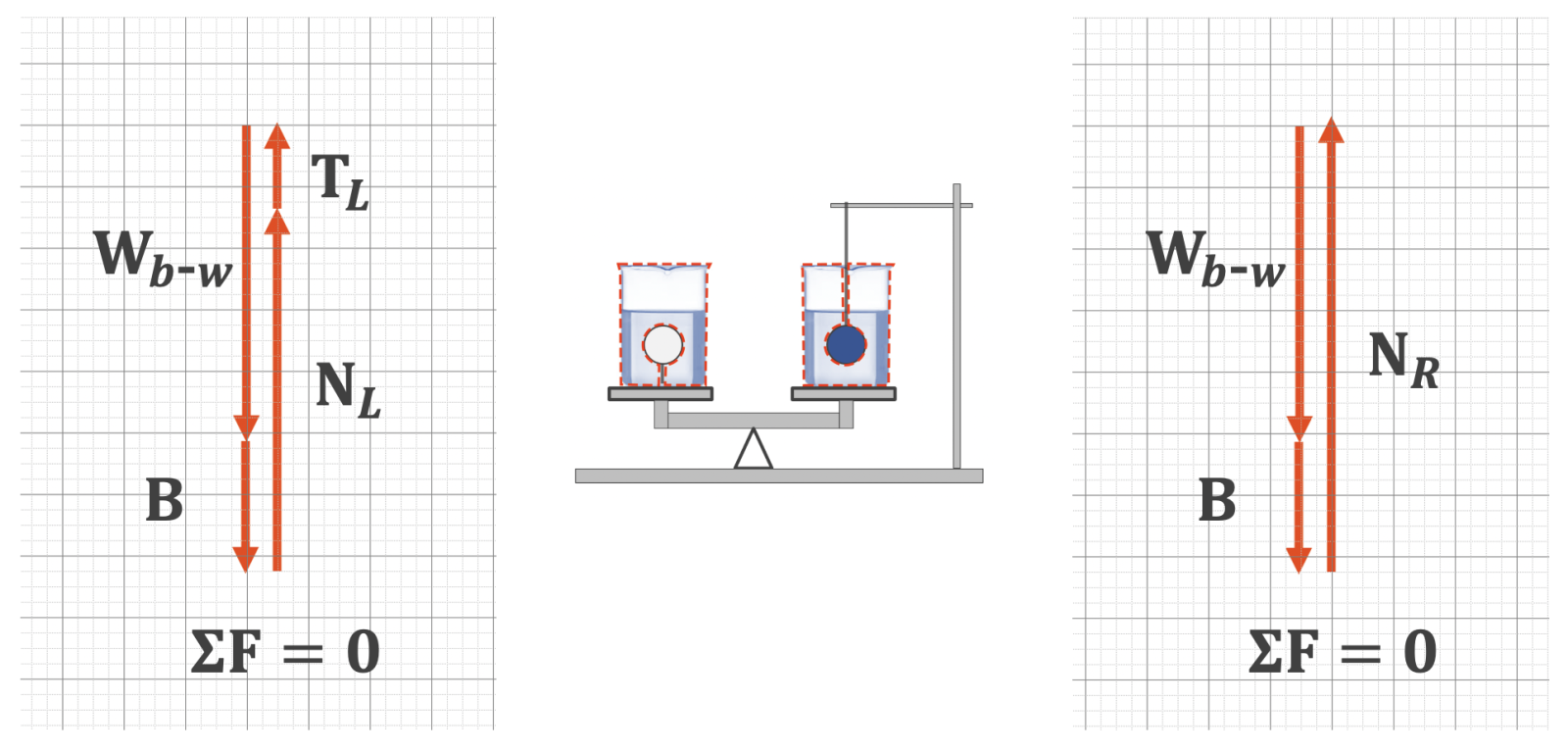
Representing what the force vectors might look like as arrows, and adding them by aligning them tip-to-tail, allows us to compare their magnitudes. On the left, weight and buoyancy are balanced by the combination of normal force and tension. On the right, weight and buoyancy are the same as on the left, but they must be balanced by normal force only. Thus, on the left, the dual-pan balance pushes up with a smaller force—and is pushed down with a smaller force.
Gro(u)ping for Math
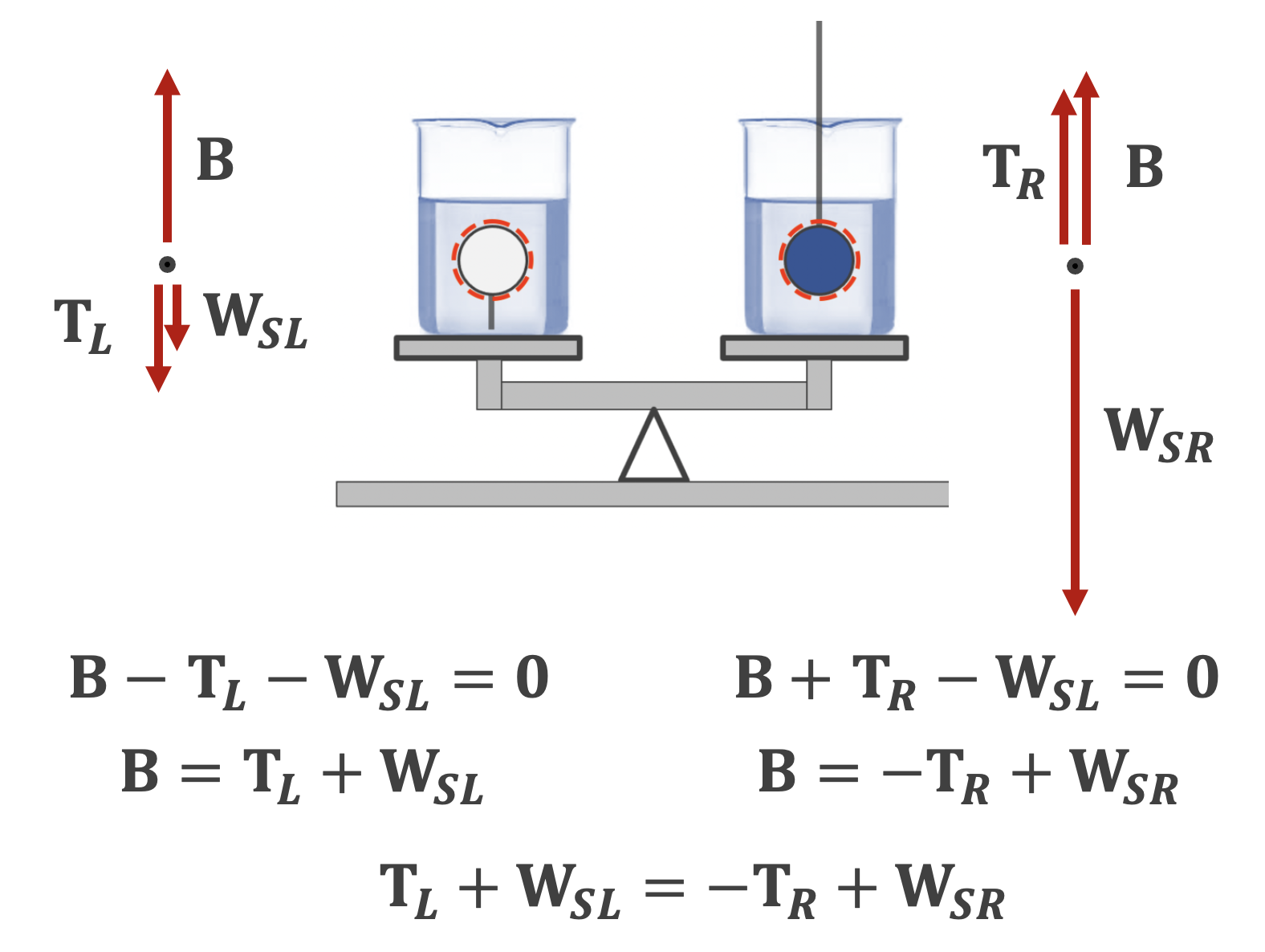
Suppose none of the insights described above had occurred to us. We still have reliable brute force ways to determine which side has the greater normal force. Here's one.
Let's look at each sphere.
Next, let's look at all of what's on each side of the balance, the beaker-water-sphere objects:
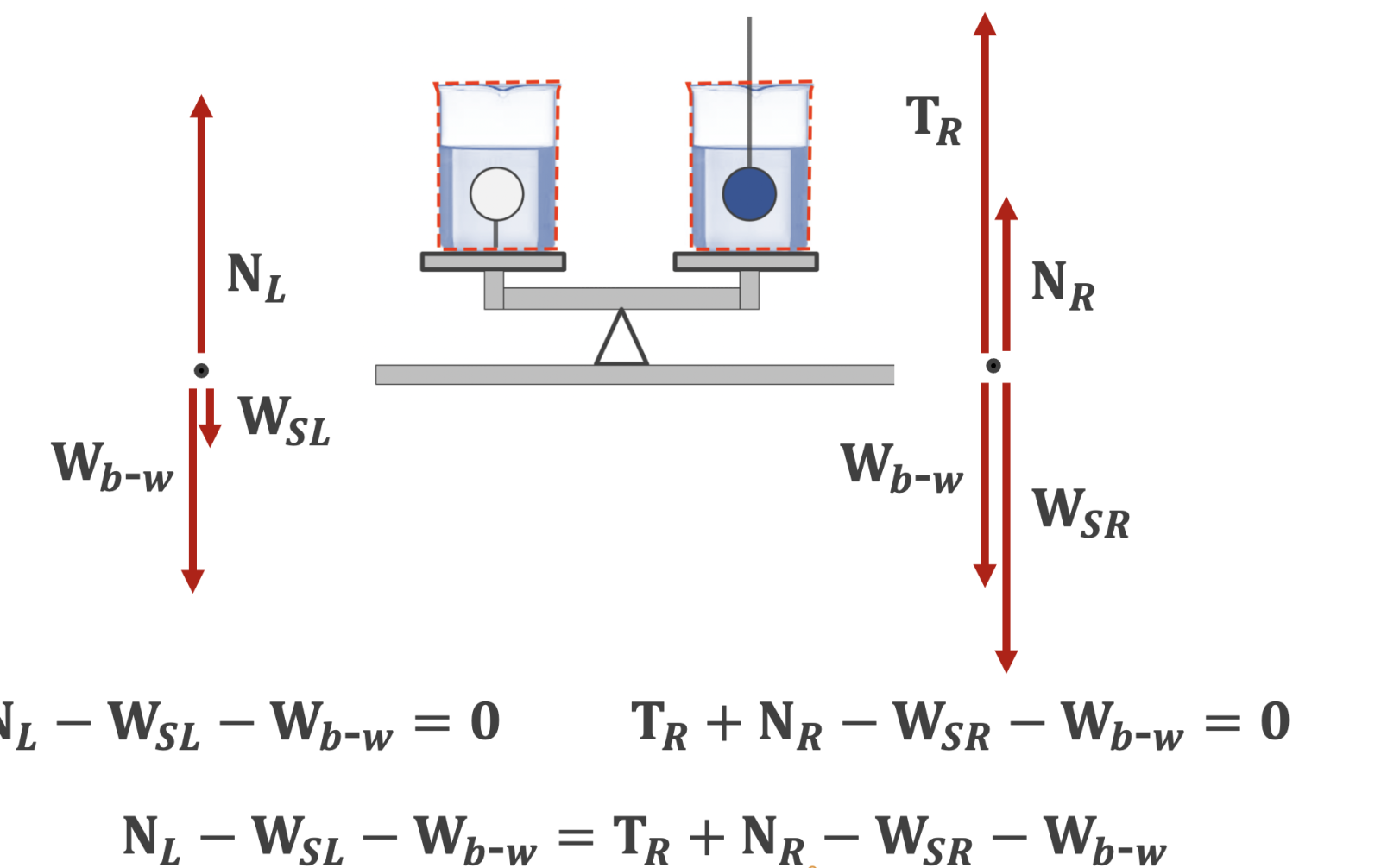
We want to know the difference of the two normal forces. Rearranging:
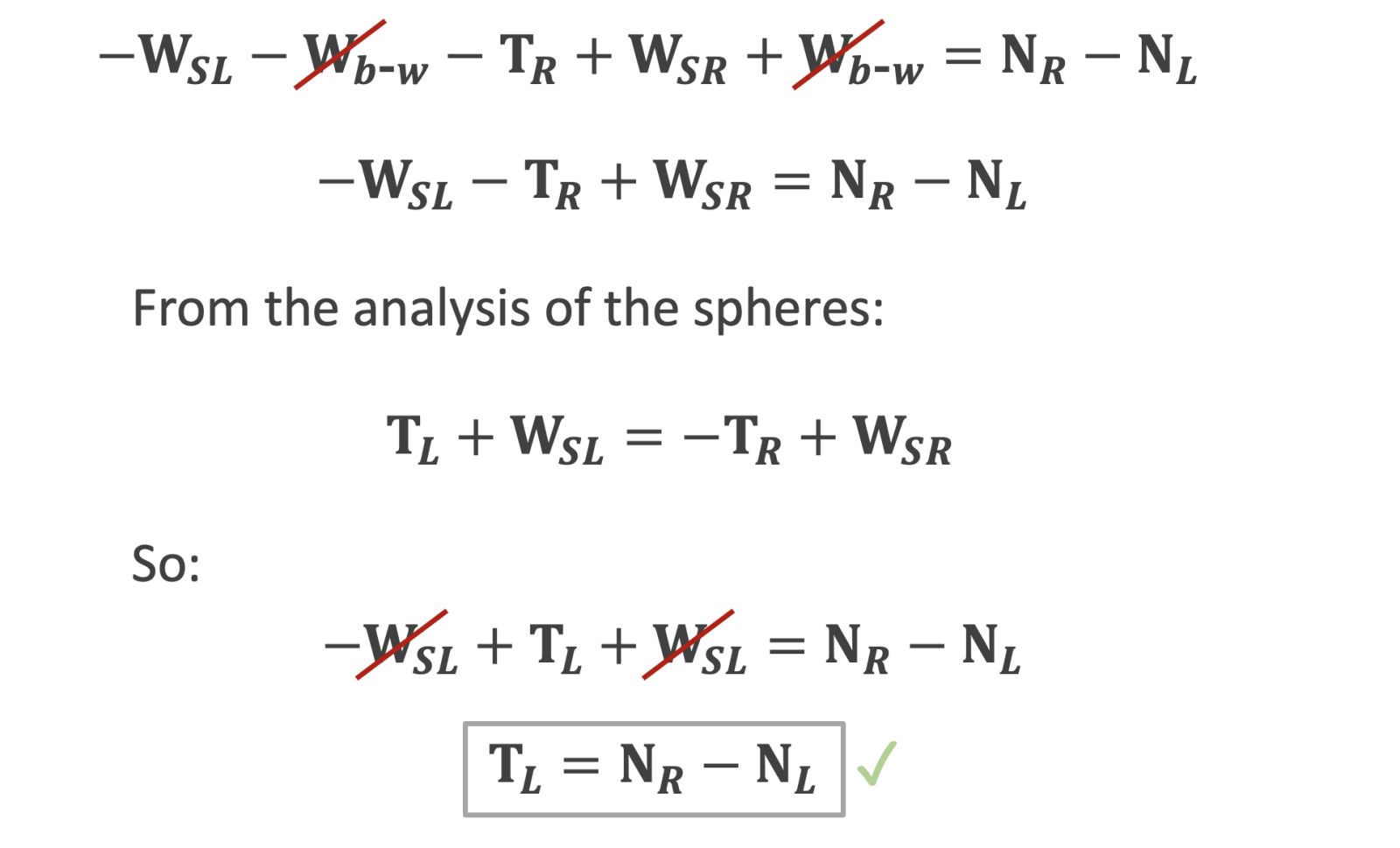
So cool! The normal force on the right is larger, by an amount equal to the tension pulling up on the left-hand beaker—exactly what we predicted by examining the beaker-water object.
Last in the Series
In a third video, Derek cut the string tethering the lightweight sphere, then pushed on the sphere with his fingers until it was fully submerged. The balance stayed... well, balanced. Revisiting the beaker-water objects: without the string to put tension on the left-hand beaker, the forces on them are identical.

SEARCH NEWS ITEMS
SEARCH ARTICLES
POSTS BY TYPE
POSTS BY TAG
POSTS BY MONTH