
Time and Space | The ShelterPhysics Blog
Posts Filtered by Tag - Skateboarding |
Show Recent Posts
August 8, 2025
Turn Posture on a Skateboard
Turn Posture on a Skateboard
One of Mitchie Brusco's excellent SkateIQ videos caught my attention, especially when he discussed body position while turning.
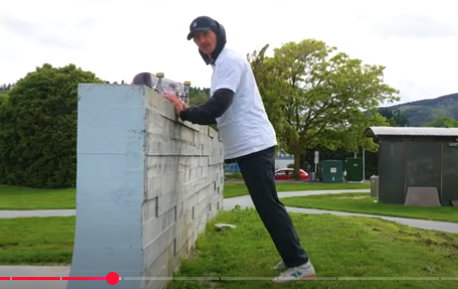
Mitchie demonstrates the correct posture for an aggressive toe-side carve (turn) with the help of a cinderblock wall.
Starting at 10:13 in the video, Mitchie requires the use of a cinderblock wall to illustrate proper body position while turning. Those who read my previous article on body position while turning on a snowboard will recognize that the wall is needed because Mitchie's center of mass is outside the skateboard trucks while turning. Unless he's actually turning on his board, he can't maintain the correct posture without falling. In this respect, snowboarding and skateboarding share the same physics.
The difference between snowboarding and skateboarding, though, is that the rider is attached to the snowboard. (What's the difference between a snowboard and a vacuum cleaner? How the dirtbag is attached.) We can much more reliably model the snowboard and its rider as a single object. For the skateboard, we need to worry about the board "following us into the turn," to use Mitchie's language. If it doesn't, we will fall.
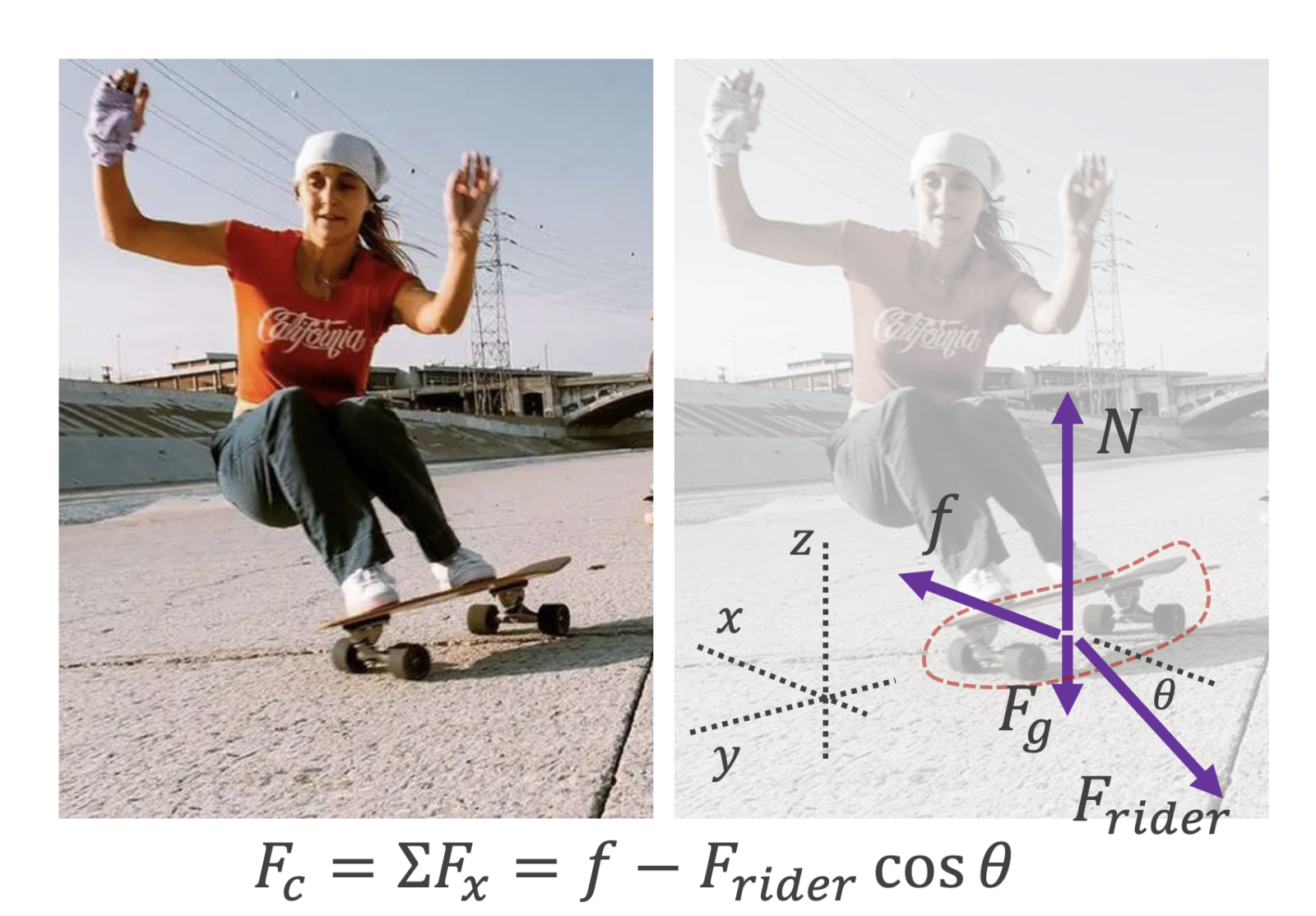
So why does the skateboard "follow us into the turn?" Let's model the skateboard as an object. It experiences a force from the rider down and to the outside of the turn. Normal force from the ground points up, gravity (on the board itself) pulls down, and friction points inward, since the board is being pushed outward by the rider. It's not obvious, though, that the friction inward would be greater than the rider's outward push, a condition which is necessary to create a centripetal force on the skateboard.
Original Photo: wake20
It turns out skateboards need a mechanism to generate centripetal force, in the form of friction. That mechanism is in the trucks, the assemblies that connect the wheels to the skateboard. The trucks are designed to respond to a skateboard leaning to one side by turning the wheels into the lean, angling them not unlike turned front wheels on a car. And like wheels on a car, the angle creates friction which forces the skateboard inward.
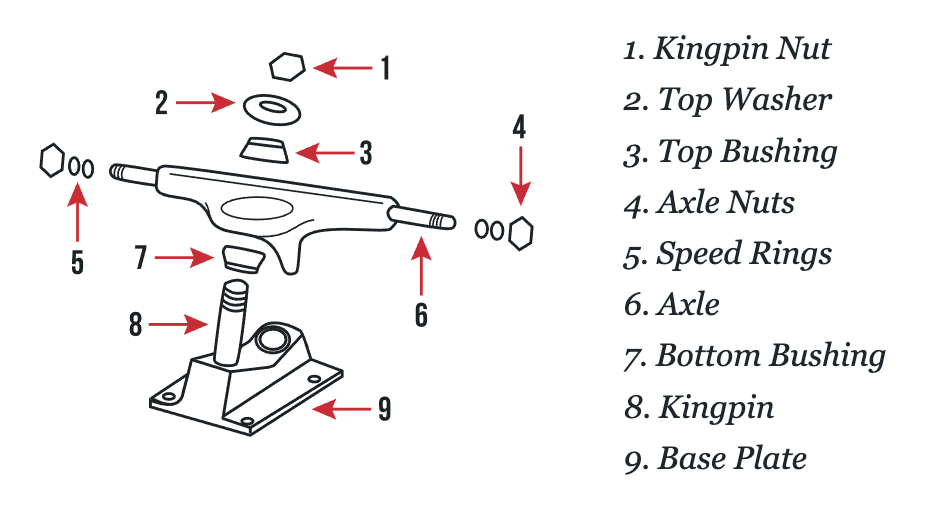
Parts of skateboard trucks. Source: SkateDeluxe
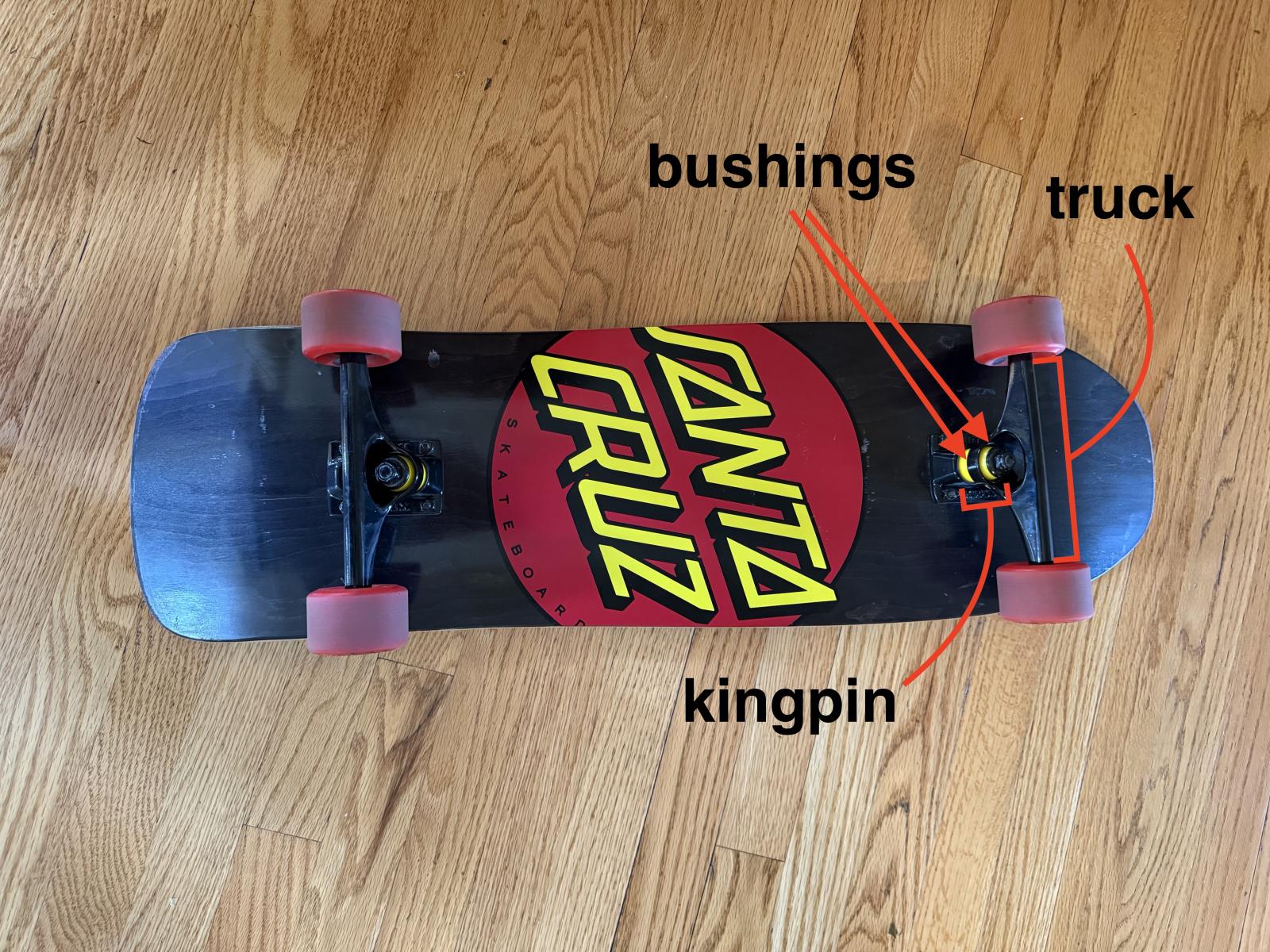
The combination of the angle of the kingpin toward the front edge of the board (front truck) or toward the back edge of the board (rear truck), combined with the shape of the bushings, pivots the axles to create additional friction directed inward during a turn.
There is so much more good physics in Mitchie's video. As he discusses how to fall without hurting yourself:
There are only a few areas that we have to protect. We do that by spreading the impacts out over a bigger surface area.
Pressure (force ÷ area) is what determines whether a person will injured during a fall. Many safety devices (helmets, pads, air bags in cars, and so on) work by spreading the force of collision over a bigger area.
Later in the video, when Mitchie is discussing how to do Ollies (jumps where the board follows you into the air), he says this:
What I want you to get the hang of is how you can hook your front foot on the nose and pick the tail up with a little bit of leverage so that your board rotates into the air like a pendulum.
In an Ollie, the tail of the board bounces off the ground and the board recoils into the air. The front foot is used to create a pivot point. The board rotates back into the horizontal position as its translational kinetic energy is converted to rotational kinetic energy and eventually to gravitational potential energy. We are not so much picking up the tail of the board as creating a fixed point which holds the nose of the board in place while allowing the inertia of the board to bring the tail up level with the nose.
Watch the full video and see how many connections you can make.

SEARCH NEWS ITEMS
SEARCH ARTICLES
POSTS BY TYPE
POSTS BY TAG
POSTS BY MONTH